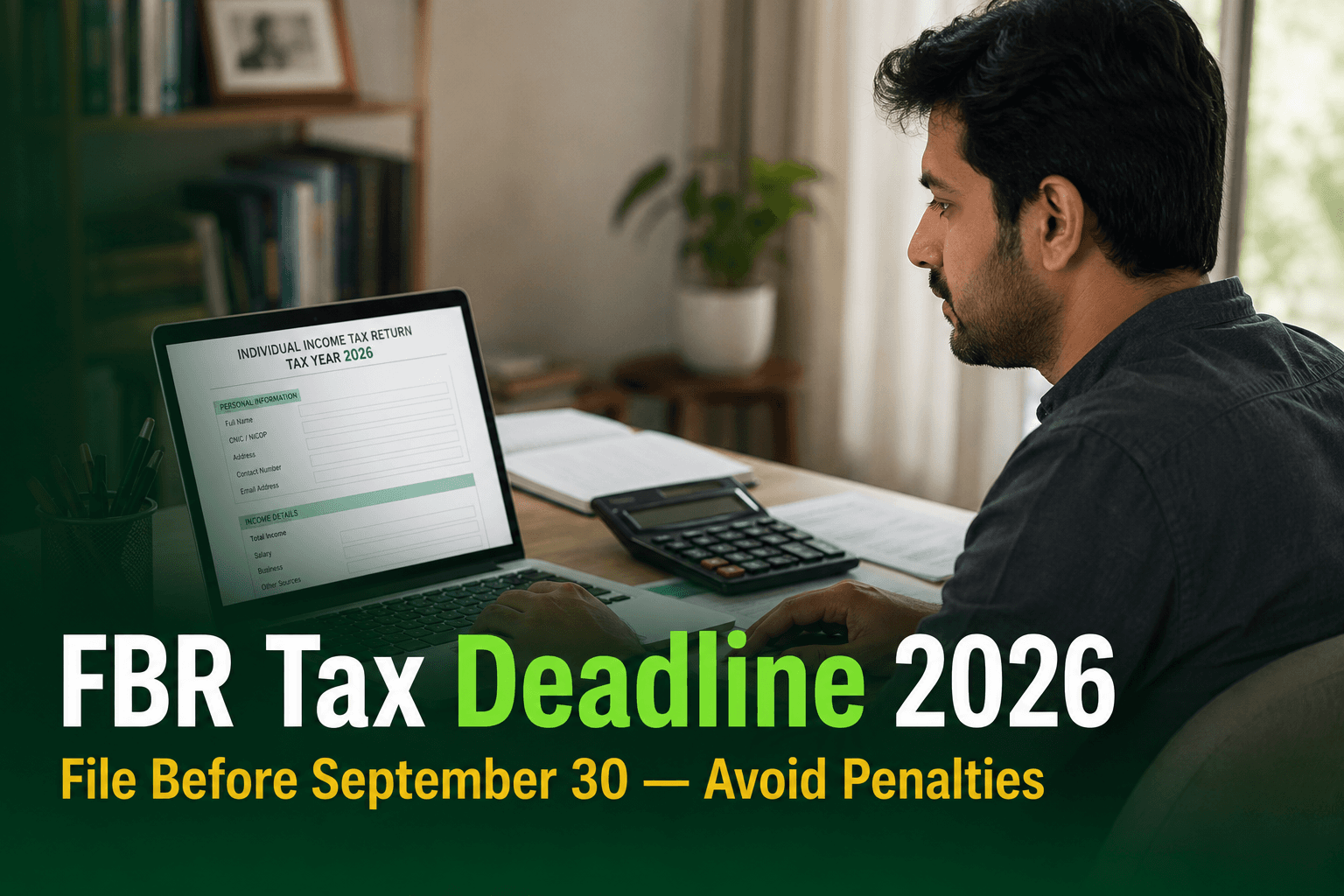
Tax season is underway, and the FBR income tax return deadline for Tax Year 2026 is a date worth marking now rather than scrambling to remember in September: September 30, 2026, for individuals and Associations of Persons.
The Deadline You Need to Know
For salaried individuals and Associations of Persons (AOPs), the Tax Year 2026 return (covering income from July 1, 2025, to June 30, 2026) is due by September 30, 2026. Companies get a longer runway, with their deadline set at December 31, 2026.
These dates anchor your entire compliance calendar for the year — filing on time keeps you on the Active Taxpayer List (ATL), which has real, ongoing financial benefits well beyond just avoiding a one-time penalty.
Why You Shouldn't Bank on an Extension
FBR's history with deadline extensions is genuinely mixed, and that inconsistency is exactly why you shouldn't plan around one:
- In some past tax years, FBR extended the deadline, in one case pushing it as late as October 31
- For a more recent tax year, FBR issued a formal press release explicitly denying extension rumors, calling them "false, baseless, and misleading," and held firm on September 30
What Happens If You File Late
| Consequence | Detail |
|---|---|
| Late filing penalty | Up to PKR 25,000 under Section 182 of the Income Tax Ordinance |
| Non-filer notice penalty | Up to PKR 50,000 under Section 114A for those who receive a notice and still don't file |
| Active Taxpayer List (ATL) status | Removed until you file and pay any applicable surcharge |
| Withholding tax rates | Significantly higher on banking, property, and vehicle transactions while off the ATL |
| "Late filer" category | A middle status (since the Finance Act 2024) with higher advance tax on property transactions than regular filers, even after you're back on the ATL |
How to File Your Return
- Visit iris.fbr.gov.pk and log in using your NTN or CNIC.
- Go to Declaration, then select Income Tax Return for Tax Year 2026.
- Complete your income and wealth statement sections thoroughly and accurately.
- Review everything carefully before submitting, since FBR increasingly cross-checks withholding, banking, and digital invoicing data against what you report.
- Submit your return and keep your confirmation for your records.
Why Filing Early Actually Matters
IRIS, FBR's filing portal, tends to run smoothly in July and August but becomes noticeably slower and more error-prone in the final week of September, when the largest volume of filers rush to beat the deadline. Filing in the first two months of the season isn't just about avoiding stress — it's a practical way to avoid technical slowdowns entirely.
Final Thoughts
Whether or not FBR extends this year's deadline is genuinely impossible to predict with certainty — and that uncertainty is precisely the reason to file well before September 30 rather than waiting to see what happens. Filing early protects your Active Taxpayer List status, avoids the late-filer penalty structure, and sidesteps the portal slowdowns that hit everyone who waits until the last week.
Official source: Federal Board of Revenue