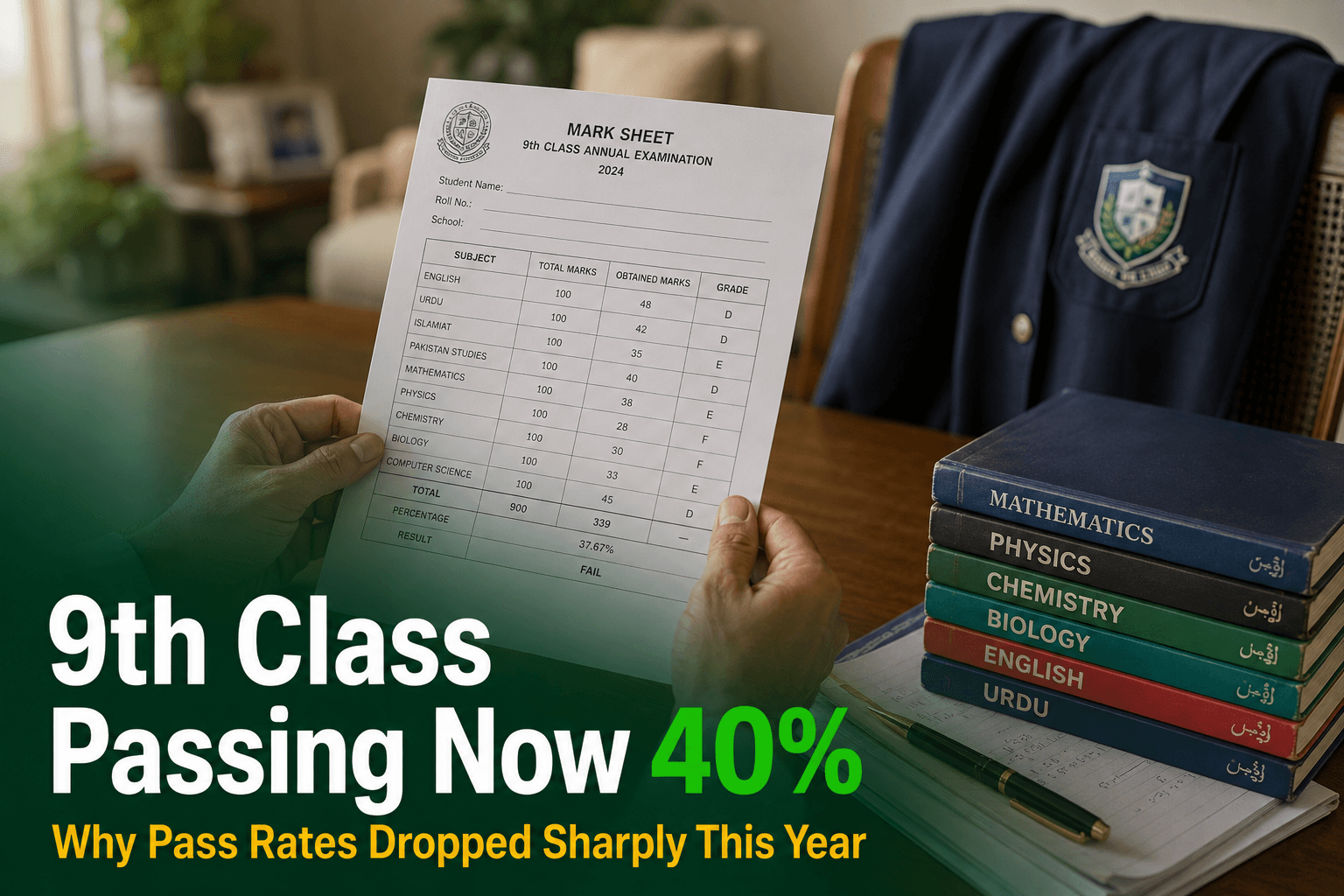
If you're wondering why this year's 9th class pass percentage looks so much lower than previous years, the answer isn't declining student performance — it's a nationwide change to the passing criteria itself, and it's catching many families off guard.
What Actually Changed
Under the revised SSC Part I grading system introduced for the 2026 academic session, students must now score a minimum of 40% in each individual paper to receive a passing grade in that subject — a significant jump from the previous 33% threshold that had been in place for years. Scoring below 40% in even one subject means that specific paper is marked as ungraded or unsuccessful, using a new grading scale that runs from A++ down to U.
This 40% passing percentage requirement currently applies specifically to 9th Class (SSC Part I) results. For 10th Class (SSC Part II), the same revised system is scheduled to take effect starting in 2027, not this year.
The Numbers: How Much Pass Rates Actually Dropped
| Board | Candidates Appeared | Passed | Pass Percentage |
|---|---|---|---|
| BISE Peshawar (9th Class) | 97,950 | 39,103 | 40% |
| Federal Board (FBISE) | 148,311 | 88,646 | 59.77% |
| BISE Abbottabad | 72,367 | 46,219 | 64.45% |
Why the Numbers Look So Different From Past Years
Historically, Punjab and other boards reported 9th class pass percentages often in the 45-65% range under the 33% passing threshold, with some years reaching significantly higher regional averages. The jump to a 40% per-subject requirement means students who would have previously passed with a bare 33-39% in a difficult subject like Mathematics or Physics are now failing that specific paper — even if their overall performance across other subjects remains strong.
A large share of the students who didn't pass outright weren't failed across the board — many, like the 57,847 recorded at BISE Peshawar, were promoted to 10th grade with one or more individual papers still pending. They continue their education normally but must clear those specific subjects in the SSC-II annual examination.
:::
What This Means If You're in Punjab
Punjab's education boards have adopted this same revised 40% passing system for the 2026 academic session. With Punjab's 9th class result scheduled for September 2, 2026, families should mentally prepare for pass percentages that may look noticeably lower than in previous years — not because performance has dropped, but because the bar for passing each individual subject has been raised.
Final Thoughts
This year's lower 9th class pass percentages across BISE Peshawar, FBISE, and BISE Abbottabad reflect a genuine policy shift, not a sudden decline in student ability. If you're a parent or student in Punjab still waiting for your September 2 result, understanding this new 40% threshold now — rather than being surprised by it later — is the best way to prepare, and to know exactly what rechecking or subject-clearing options exist if the result doesn't go as expected.
Official source: Check your specific board's website (e.g., fbise.edu.pk, bisep.edu.pk)